
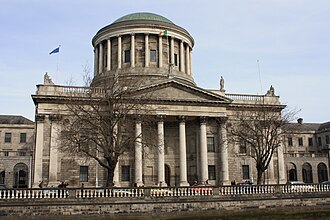
Four Courts after dark offers a focused way to explore Dublin’s legal and civic past at a time when the stone façades, river light and narrow quays sharpen the sense of history. This route pairs verifiable legal and Civil War history around the Four Courts complex with the local ghost lore that grew up afterward, so you can experience atmosphere without confusing legend for fact. The walk is designed for adults and curious families, history-minded visitors and anyone who prefers guided, safe night-time exploration of Dublin’s central streets.
Book the Four Courts After-Dark Ghost Route with Ghost Tour Dublin Experience
Documented history at Four Courts
The Four Courts complex has been the heart of Ireland’s legal system for centuries. Architecturally and institutionally, the buildings represent the city’s role as an administrative and legal centre. What is beyond dispute is that Four Courts suffered catastrophic damage during the 1922 Civil War. Explosions and fires in the complex destroyed courts, records and parts of the fabric of the buildings.
One of the most consequential outcomes of the 1922 fighting was the loss of large swathes of Ireland’s archival material stored in the Public Records Office within the Four Courts complex. That loss remains a key, documented reason why genealogical and administrative records from a range of earlier periods are now incomplete.
Separating history from legend
Dark places attract stories. Around Four Courts, folklore often stitches together real wartime trauma and the human imagination. Common tales include claims of phantom footsteps in vaults, cold spots near blast-scarred stone, and the whisper of clerks long gone. These stories are culturally significant as modern folklore, but they are not the same as documented evidence.
When discussing hauntings, it helps to separate three categories: verified historical fact, well-attested eyewitness accounts, and local legend. The Civil War damage and archival loss are verifiable facts recorded in contemporary accounts and subsequent histories. Eyewitness accounts of unusual experiences are personal testimonies—valuable to local culture but not proof of apparitions. Finally, many specific ghost stories are folkloric: retellings that change over time and mix imaginative detail with memory.
The after-dark route: step-by-step stops
This route is practical for a 60–90 minute evening walk. Each stop is chosen for historical resonance, atmospheric sightlines and safe public access.
1. Four Courts façade (starting point)
Begin on the quayside facing the classical façade. By night the lit portico, columns and dome read as a civic monument. Historical note: this is the face of an institution that housed both the courts and, until 1922, the Public Records Office. Look for repaired masonry and plaques that acknowledge the building’s interrupted history.
2. Riverside quays
Walk along the riverbank to take in the transportation and trade context that shaped legal Dublin. The currents, bridges and steps give a sense of how access to the courts was experienced in earlier centuries. At dusk the light off the water changes the scale of buildings and enhances the mood for stories about the city’s turbulent decades.
3. Site of the lost archives (exterior viewing)
Stand at the area associated with the archives’ former storage. You cannot enter original archival vaults on a public ghost walk, but the exterior tells the story of destruction and replacement. Use this stop to reflect on the human cost of conflict: legal documents, family records and administrative ledgers that helped orient later generations were lost here.
4. Nearby legal precinct and streetscape
Finish by threading through the nearby legal precinct, where modern courts, practitioners’ offices and Georgian streets coexist. Historical notes here point out how the legal profession rebuilt and adapted after wartime damage. These streets also feed many of the tales of lingering presences—stories that, while evocative, belong to local folklore rather than court records.
On-the-ground guide: best times, lighting, safety and access
Best times: Schedule the route after civil twilight, when the façades are lit but before the city becomes too quiet. Weekdays after 7pm and early weekend evenings are popular. Avoid very late hours when streets can be emptier and less well-lit.
Lighting and visibility: Stick to lit routes along the quays and main footpaths. The area is urban and CCTV and street lighting are present in main thoroughfares, but side lanes can be dim. Bring a small torch or use your phone light for darker stretches.
Safety tips: Stay on public footpaths, cross at designated crossings, and keep to groups—especially at night. Keep valuables secure, wear visible clothing if possible, and be mindful of traffic on the quays.
Photography: Night photography can be rewarding—use a tripod or steady surface for long exposures. Avoid flash if you want to maintain atmosphere. Be respectful when photographing close to court entrances; do not obstruct access or security staff.
Accessibility: Much of the route follows level quays and main pavements, but uneven paving and occasional steps are present. If you need a fully level route or personal assistance, check with the operator in advance; many commercial tours can suggest accessible alternatives or adapt stops.
What to expect on a guided tour vs. a self-guided visit
Guided tour: A commercial, after-dark guided tour offers curated commentary, historical context and safety in numbers. A guide can clearly indicate which material is strictly documented, which is eyewitness testimony, and which is folklore. Typical guided experiences include small groups (often 10–20 people), a 60–90 minute duration, and a route designed for visibility and access.
Self-guided visit: Self-guiding is possible for confident walkers who are comfortable navigating at night and separating sources. It requires prior reading and planning to avoid misattributing folklore as history. For those who enjoy writing, consider pairing visits with research ideas such as local souvenir concepts—see Merch Ideas for a Dublin Dark Tourism Blog for inspiration and ethical souvenir practices.
Responsible visiting and preservation
Four Courts is not a museum: it remains part of a living legal precinct. Respect working offices, staff, signage and security barriers. Do not touch or climb on historical masonry, and do not attempt to enter restricted areas. Dark-history tourism is at its best when it supports preservation: leave no litter, stay on paths, and consider small acts of support such as micro-donations for local research and interpretation programs.
If your interest in dark-history merchandising extends beyond souvenirs, you can learn about ethical approaches at Micro-Donations for a Dublin Ghost Blog: Funding Haunted Places & Tours, which outlines ways to support local storytelling and conservation without exploiting fragile sites.
Practical details: how to book, operators, weather and footwear
How to book: For the most reliable narrated experience, book with a licensed operator. We recommend booking in advance to secure the evening time you want—especially during summer and holiday weekends. Reserve your spot now: Book the Four Courts After-Dark Ghost Route with Ghost Tour Dublin Experience.
Private and group bookings: If you are organising a private group, corporate evening or educational visit, many operators offer bespoke departures. For private groups and tailored itineraries, see the private groups page at our booking site.
Weather and footwear: Dublin evenings can be damp and changeable. Dress in layers, bring a waterproof jacket, and wear sturdy, comfortable shoes with good grip. Umbrellas can be awkward on narrow quays—pack a hood where possible.
Recommended operators: Choose operators with clear safety guidance, visible insurance and good reviews. A professional guide will make transparent distinctions between historical fact and folklore, and will respect the working nature of the precinct.
Further reading and linked routes
If you want to extend your interest in Dublin’s night-time histories, consider neighbouring routes that explore other corners of the city’s dark past. The South Circular Road Twilight Ghost Trail covers a different set of urban stories and atmosphere. For servant folklore in a civic setting, the Dublin Castle Servant Ghost Stories guide is a useful companion. For canal-side tales, see Drimnagh Canal Ghost Tales for another style of night walk. If you plan memorabilia or content projects, don’t miss Merch Ideas for a Dublin Dark Tourism Blog for thoughtful souvenir approaches.
Book the Four Courts After-Dark Ghost Route with Ghost Tour Dublin Experience
FAQ
How long is the Four Courts after-dark ghost route and where does it start?
The route is typically 60–90 minutes depending on the operator and the number of stops. Most guided walks start on the quays facing the Four Courts façade so participants can view the building, proceed along the riverside and finish in the nearby legal precinct.
Are the hauntings at Four Courts based on documented evidence or local folklore?
The Civil War damage and archival loss at Four Courts are documented historical facts. Reports of hauntings fall into eyewitness accounts and folklore. Guides should make clear which elements are documented and which are local legend—reputable tours will indicate the distinction throughout the walk.
Is the route suitable for children and is it accessible for people with mobility issues?
Children can join with parental supervision; content can be tailored by some operators to be family-friendly. Accessibility varies: much of the route is on level pavements, but there are uneven stones and occasional steps. Contact your chosen tour operator in advance to discuss accessibility needs or to request an adapted route.
Should I join a guided tour or is it safe and legal to walk the route on my own?
Both are possible. A guided tour adds historical context, safety in numbers and clear separation of fact from folklore. A self-guided walk is legal in public spaces but requires careful planning, awareness of safety at night and respect for the working court precinct. If you value commentary and a curated experience, book a guided tour.