
Ha’penny Bridge ghost crossings — Night walk guide & stories | Ghost Tour Dublin Experience
Ha’penny Bridge ghost crossings — Night walk guide & stories
The Ha’penny Bridge is one of Dublin’s most photographed landmarks by day and one of its most whispered-about sites by night. Its small, graceful span over the Liffey, combined with a long public life and a steady flow of pedestrians, has produced an unusual mix of documented municipal history and a wide array of local folklore. This guide helps visitors separate what is recorded from what is told around pub tables, and gives practical, safety-minded advice for including the bridge on a respectful night walk.
Book your Ha’penny Bridge night walk with Ghost Tour Dublin Experience
Introduction: Why the Ha’penny Bridge attracts ghost stories
Small, central and intimate, the Ha’penny Bridge invites attention. Bridges are liminal places — points of crossing and transition — and human imagination has long attached stories about passage, loss and lingering presences to them. In Dublin, the bridge’s visible wear, its footfall soundscape at night and the continuity of use across generations feed a landscape of anecdote. People who have grown up nearby, commuters who passed it at dawn or shift-workers returning late have all contributed to the archive of accounts that now reads as a mixture of memory, suggestion and legend.
Documented history of the Ha’penny Bridge and its Victorian‑era context
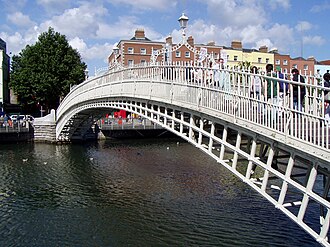
Distinguishing documented history from folklore is essential before you interpret a shadow on the bridge. The Ha’penny Bridge is a pedestrian cast‑iron structure erected in the early 19th century to replace earlier ferry crossings at that point on the Liffey. Its name comes from the small toll once required to cross it — an element tied to municipal transport history rather than any supernatural claim.
The bridge sits within a Victorian and Georgian urban fabric: warehouses, quays and late Georgian streets that were centers of commerce and daily life. These working histories produced accidents, grief and hard lives that later fed oral stories. Whatever one believes about ghosts, the area’s social history — the workers, the river traffic, the night-time rhythms — is well documented in municipal records and urban studies, and it’s the factual backdrop against which folklore developed.
Reported sightings and common motifs — separating folklore from fact
Reports associated with the Ha’penny Bridge tend to fall into a handful of motifs rather than consistent, verifiable incidents. Common themes include: fleeting figures that vanish at the bridge’s railings; unexplained cold spots or drafts; the sensation of being watched; and the impression of footsteps when the bridge appears empty. These are classic urban‑ghost motifs and fit patterns found across many cities.
It’s important to separate three layers when you evaluate a claim: documented events (accidents, legal records, maintenance logs), personal eyewitness accounts (often vivid but subjective), and folklore (stories repeated and embroidered across time). Many stories about apparitions on the bridge are best classified as folklore or personal encounter rather than documented phenomena. For context on these recurring motifs across Dublin, see our quick reference to local patterns at Cataloguing Dublin’s Urban Ghost Motifs: A Quick Reference for Guides & Visitors.
Eyewitness patterns: when, where and what visitors typically report
When accounts are compared, some patterns emerge. Most reports occur late in the evening or in the small hours when pedestrian traffic is sparse. Witnesses often describe seeing a figure near the central span or the bridge’s southern approach; others mention a feeling of sudden cold or a vague sense of not being alone. A significant number of accounts are brief and visual — a silhouette in peripheral vision that disappears when looked at directly.
Many experiences are shaped by expectation. If a group arrives hoping for an encounter, small sensory cues — a gust of wind, distant traffic noise, or a dog barking — can be interpreted as more than they are. That said, repeated mentions of a particular sensation in the same place at similar hours are useful data for guides: they inform where to pause during a tour and how to brief guests about what to expect without encouraging alarm.
How to include Ha’penny Bridge on a safe, respectful night walk (route and timing)
A safe, respectful night walk treats the bridge as part of the living city. Plan your route to avoid congestion and private property. A typical loop starts from a central meeting point on the quays, approaches the Ha’penny Bridge from the northbank, crosses to the southbank for viewing angles, and continues to nearby historic stops. Keep group sizes manageable to minimise disruption to other pedestrians and to allow quiet moments for reflection or storytelling.
Best timing for atmospheric conditions and fewer crowds is after evening peak hours but before very late-night activity — roughly an hour after dusk or later on weekdays when bars and venues are quieter. Consider seasonal changes: autumn and winter provide longer evening darkness, but colder temperatures mean more layers and shorter walks. Always check local regulations and be mindful of residential areas when planning late finishes.
Photography, equipment and etiquette for ghost‑hunting tourists
If you aim to photograph atmospheric moments, bring equipment suited to low light: a tripod or a stable surface, a camera with good high‑ISO performance or a smartphone with night mode. For practical gear advice, our guide to lighting and accessories is a helpful companion: Affordable Lighting Gear for Dublin Night Tours — Practical Guide for Guides & Visitors.
Etiquette matters. Keep voices low, avoid obstructing the bridge’s footpath, and be courteous to locals crossing. If you plan to use a tripod on the bridge, be ready to step aside quickly to allow free passage. Respect signage and barriers; they are there for safety and heritage protection. Finally, don’t stage or fabricate phenomena for photos; this harms the credibility of genuine witnesses and disrespects local stories.
Combining the bridge with nearby haunted stops and how to book a guided tour
The Ha’penny Bridge sits within a compact walking area that allows logical combinations with other dark‑history stops. Consider pairing your walk with the industrial echoes near Blackpitts for a different tonal section: Blackpitts Old‑Brewery Apparitions and Industrial Echoes — A Visitor’s Dark History Guide. Georgian squares close to the city centre, such as Mountjoy Square, make for quiet, austere additions: Mountjoy Square Ghost Trail — Georgian Squares After Dark. If you prefer village legends and a milder, community‑oriented route, consider Ranelagh: Ranelagh After‑Dark Folklore Walk: Village Legends, History & Visitor Guide.
For visitors wanting a guided experience that balances history, credible eyewitness testimony and safe exploration, we recommend booking a guided night walk. Our tours are designed to be informative, respectful and paced for photography and small‑group conversation. Book your Ha’penny Bridge night walk with Ghost Tour Dublin Experience
We also accommodate private groups and tailored routes for corporate or family bookings — if you prefer an exclusive tour with flexible timing and a customised focus on history versus folklore, please contact us to arrange a private group experience at: Private groups and bespoke tours.
Practical safety notes and final considerations
Safety first: wear sensible footwear, bring layers, and always carry a charged mobile phone. Keep to public footpaths and bridges, and avoid venturing into dark alleys or non‑public riverbanks. If your group includes children or people with mobility needs, plan routes with fewer steps and more seating stops.
Respect is also critical. Many of the stories attached to the Ha’penny Bridge arise from memories of hardship and loss. Use the night walk to listen as well as to observe: respectful storytelling preserves the dignity of lived experience and makes for a more memorable, honest tour.
FAQ
Are the Ha’penny Bridge ghost sightings documented or just folklore?
Most reports connected to the Ha’penny Bridge are personal eyewitness accounts or stories passed down locally rather than formally documented phenomena. The bridge’s municipal history—its construction, tolling system and maintenance—are part of the public record, but supernatural claims are primarily anecdotal and best treated as folklore unless corroborated by verifiable evidence.
Is it safe to visit the Ha’penny Bridge at night?
Yes, the area around the Ha’penny Bridge is generally safe for visitors who follow basic precautions: stay on well-lit paths, travel in small groups when possible, wear appropriate footwear, and avoid obstructing pedestrian flow. Booked guided tours add an extra layer of safety and local knowledge.
When is the best time for a ghost walk to catch atmospheric conditions?
For atmosphere and fewer crowds, an hour or so after dusk on weekdays is often best. Autumn and winter provide longer darkness, which can enhance mood, while late spring and summer still offer pleasant temperatures for longer walks. Weather changes rapidly in Dublin, so check forecasts and dress in layers.
Can I stand on the bridge during a guided tour and take photos?
Yes — guided tours typically include scheduled pauses on or near the bridge where photography is possible. Please follow your guide’s instructions about positioning and time so other pedestrians can pass, and avoid setting up equipment in a way that blocks the walkway. If you plan to use a tripod, be prepared to move when asked.