
St Mary’s Abbey Ruins: Monastic Echoes and Sightings — Visitor Guide
St Mary’s Abbey ruins: monastic echoes and sightings attract visitors who want both a solid sense of Dublin’s medieval past and a measured look at the stories that gather around old stone. This guide is intended for practical visitors—photographers, history lovers and evening-walkers—who want to read the fabric of the ruins, understand what is historically documented, and separate that evidence from folklore and modern witness reports.
Book a Ghost Tour Dublin Experience — join an evening walk that blends historical background with a careful, evidence-aware look at the stories associated with St Mary’s Abbey. Tours are led by guides who focus on respectful interpretation and visitor safety.
Documented history: Foundation, medieval monastery life and dissolution (what records show)
St Mary’s Abbey was established during the medieval period as one of Dublin’s major monastic houses. Surviving documentary traces and archaeological investigation indicate it functioned as a living religious community with the usual components of monastic life: a church for worship, cloistered spaces for meditation and walking, communal halls such as a refectory, and ancillary buildings for storage and craftwork.
Documents that survive in civic and ecclesiastical archives make clear the abbey held lands and influence in the city and surrounding countryside. Like many monastic institutions across Ireland and Britain, its fortunes changed dramatically when religious and political reforms altered property ownership and the pattern of religious life. After dissolution, the buildings and estate were repurposed over time and much of the monastic complex fell into disrepair.
Where records are explicit they tend to cover legal transactions, property descent and administrative matters rather than sensational stories. For visitors this is important: the verifiable record is strongest around property and institutional change; the ghost stories belong to oral tradition and later local memory.
The ruins today: What remains, how to read the stones and visible monastic features
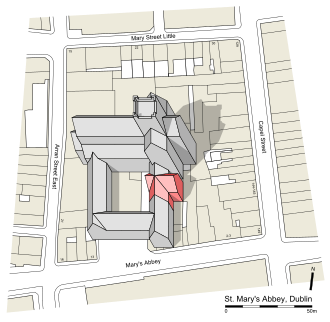
The surviving ruins are fragmentary but instructive for the patient observer. Stone walls, partial arcades and foundations indicate the original footprint of the church and cloister. Look for changes in masonry and tool marks that suggest different building campaigns and later repairs. Reused stones and later additions often tell a layered story of reuse after dissolution.
When you walk the site, read the masonry from bottom up: older ashlar or roughly dressed blocks, later patching and mortar fills mark successive eras. Vaulted undercrofts or remnants of cellars often survive beneath later street level and can give a sense of subterranean activity—storage, workrooms and cryptic, cooler spaces where echoes travel differently.
Interpretive panels or guide commentary can point out specific architectural elements such as a nave alignment, chapel projection or cloister walk. If you visit with a knowledgeable guide, those details will become easier to identify and place within the broader medieval cityscape.
Reported sightings and sensations: Separating recorded accounts, witness reports and local folklore
Accounts connected to St Mary’s Abbey fall into three broad categories: documented, contemporary witness reports, and folklore or legend. Keeping these categories distinct helps visitors assess claims critically while appreciating the cultural value of stories.
Documented accounts
Documented accounts are those you can find in archives, newspapers or official records. For St Mary’s Abbey most documentary evidence concerns property, legal disputes and administrative details. There is little in the formal record that confirms supernatural events; official documents were not the typical place for reports of apparitions.
Contemporary witness reports
Modern witness reports—testimonies from people who say they experienced unusual sensations at the ruins—are common in any evocative historic site. Visitors frequently describe sudden drops in temperature, a feeling of being observed, or fleeting glimpses at the edge of vision. Such experiences are subjective and can be influenced by atmospheric conditions, acoustics in ruined spaces, or expectation after hearing a story.
Evaluating these reports benefits from an evidence-aware approach: note environmental explanations (wind, ambient noise, lighting), the influence of group dynamics (suggestibility), and the time of day. That said, first-person testimony is still valuable as part of the living folklore that surrounds the place.
Folklore and legend
The richest layer is local folklore: tales of cloistered monks, phantom processions, and distant bells are part of Dublin’s oral fabric. These stories are culturally meaningful even when they’re not verifiable. Treat them as narratives that reveal how later generations interpreted and imagined the abbey—stories that connect contemporary Dubliners with the city’s medieval past.
Visiting logistics: Hours, access, best times for light and after-dark visits, safety and etiquette
Practicalities matter. Ruins are often within public areas but may be bounded by modern property or cordons. Before you plan a visit check local signage and municipal information for access restrictions. If a gate is locked or there’s clear signage, respect those limits; many ruins are fragile and need protection.
For photography and architectural appreciation, the best light is generally the hour after sunrise or the hour before sunset—soft, low-angle light that reveals texture and depth. For atmosphere and the chance to hear evening sounds, guided after-dark tours create a safer environment than wandering alone; they combine access, local knowledge and a managed group setting.
Safety: wear sturdy footwear, avoid climbing on unstable masonry, and keep a safe distance from excavated areas or fencing. Etiquette: treat the site as a place of historic significance—no graffiti, no disturbance of any fragile fabric, and keep noise low if others are visiting or if solemn commemoration is occurring nearby.
Guided options and commercial tours: What to expect on a Ghost Tour Dublin Experience and how to book
Guided experiences balance storytelling with historic context. On a Ghost Tour Dublin Experience you can expect a guide who frames the abbey’s history first and then discusses the layers of sightings and folklore with an evidence-aware tone. Guides highlight architectural features, explain how the site fits into medieval Dublin, and present witness reports with context rather than assertion.
For those who want a more intimate or private exploration, small-group and private tours are available—ideal for photographers or groups who prefer a tailored route. If you’re arranging a private hire for a group, mention your interest in photography or any access needs when booking so the guide can accommodate you.
Book a Ghost Tour Dublin Experience to join an evening walk that blends documented history with the atmospheric stories associated with St Mary’s Abbey. For private groups and tailored experiences, contact the Ghost Tour Dublin Experience team via the booking page to discuss arrangements and permissions.
Photography, preservation and neighbouring sites
Photography for personal use is usually acceptable where public access is allowed; however, professional shoots, tripods or commercial use often require permission from the landowner or the city authority. If in doubt, ask a guide or check the local municipal guidance before setting up. Respect preservation: avoid touching fragile carvings, stepping on exposed foundations, or moving loose stones for a better camera angle.
While you’re exploring, consider pairing the abbey with nearby themed walks and sites. For literary connections, see Bram Stoker’s Dublin: Pubs and Places That Inspired Dracula. For evening folklore in a different neighbourhood, the Ballsbridge Twilight Folklore District Guide is a complementary evening option. If your interest leans toward darker civic history, the 18th-Century Execution Sites guide explores justice-related hauntings and walking routes. For an atmospheric after-dark alley experience, the Temple Bar Hidden Alleys Night-Walk offers another perspective on Dublin’s nocturnal stories.
For tour operators and guides interested in pricing and expectations for virtual or in-person experiences, see our guidance on Money & Pricing for Virtual Dublin Ghost Tours.
Book a Ghost Tour Dublin Experience — reserve a spot on an evening walk that foregrounds historical accuracy while discussing the sightings and legends that continue to interest visitors. For private groups, tailored routes and permission inquiries, use the booking link and specify “private group” in your request to arrange a bespoke visit.
FAQ
Can I visit St Mary’s Abbey ruins on my own or is a guided tour recommended?
You can often view the ruins independently from public thoroughfares, but access onto sensitive parts of the site may be restricted. A guided tour is recommended for after-dark visits, deeper explanation of the architecture and safer access to nuanced information. Guides also help interpret features that are otherwise hard to place without background knowledge.
Are the reported ghost sightings historically documented or purely folklore?
Most ghost stories around St Mary’s Abbey belong to folklore and contemporary witness reports rather than formal historical records. Documentary sources focus on property and institutional matters; sightings are usually part of oral tradition and personal testimony. Both are valuable, but they belong to different evidentiary categories.
Is the site suitable for children and is it safe after dark?
The site can be suitable for children if boundaries are observed and guardians keep close supervision. After dark, guided tours provide a safer, managed environment; unaccompanied children should not visit ruins alone at night. Wear appropriate footwear and follow all safety guidance from signage or your guide.
Do I need permission or pay a fee to photograph the ruins or run a tour?
For casual photography in public areas you generally do not need permission, but commercial photography, tripods or professional shoots may require permission from the landowner or local authority. Running organised tours may also require permits depending on the location and group size—when in doubt contact the relevant municipal office or book through an established operator such as Ghost Tour Dublin Experience to ensure compliance.